

For a little context, I have been working on the history of the building that became the Museum of Science and Industry. When reading about the acres of art on display, I came across a reference to three 8-foot cloisonne objects—two vases and a censer—from Japan and how they took some time to get to the Palace of Fine Arts. They’d been relegated to the Manufacturing and Liberal Arts building. I also went to a talk last week about the Japanese pavilion at the World’s Fair in which the presenter mentioned that the Japanese didn’t have a concept of Fine Arts until Commodore Perry sailed in. The West might dismiss objects as crafts or decorative arts but those objects for the Japanese embodied all the artistry and soul that any art had.
I also remembered that I’d done citizen work a few years ago transcribing diaries of people who had been to the fair for the Newberry Library. One lady from the north side of Chicago went to the fair several times a week and grew to be good friends with the Japanese curator in the Fine Arts building, so I tried to see whether I could figure out his name as part of this story. In the search for his name, I stumbled into yet another example of the strange life of artifacts.
I’m fairly sure the friend the lady made was Mr. Shin Shinwoda, Special Counsellor for Arts of the Japanese Commission to the World's Columbian Exposition, a representative of the emperor. Japan very much wanted to use the fair to demonstrate that Japan was the equal of any Western power and he’d realized that art was cultural power. They poured a lot of money and effort into the gorgeous Ho-o-den Pavilion on Wooded Island and their presence in the Palace of Fine Arts. Exhibitors put tremendous effort into making a big splash with big objects. He had a vision of the three enormous cloisonne works of art and had worked with the finest artists for years to complete them. They are stunningly beautiful. The iconography was significant. It pays tribute the stars and stripes of the United States on the neck and with eagles on the body.
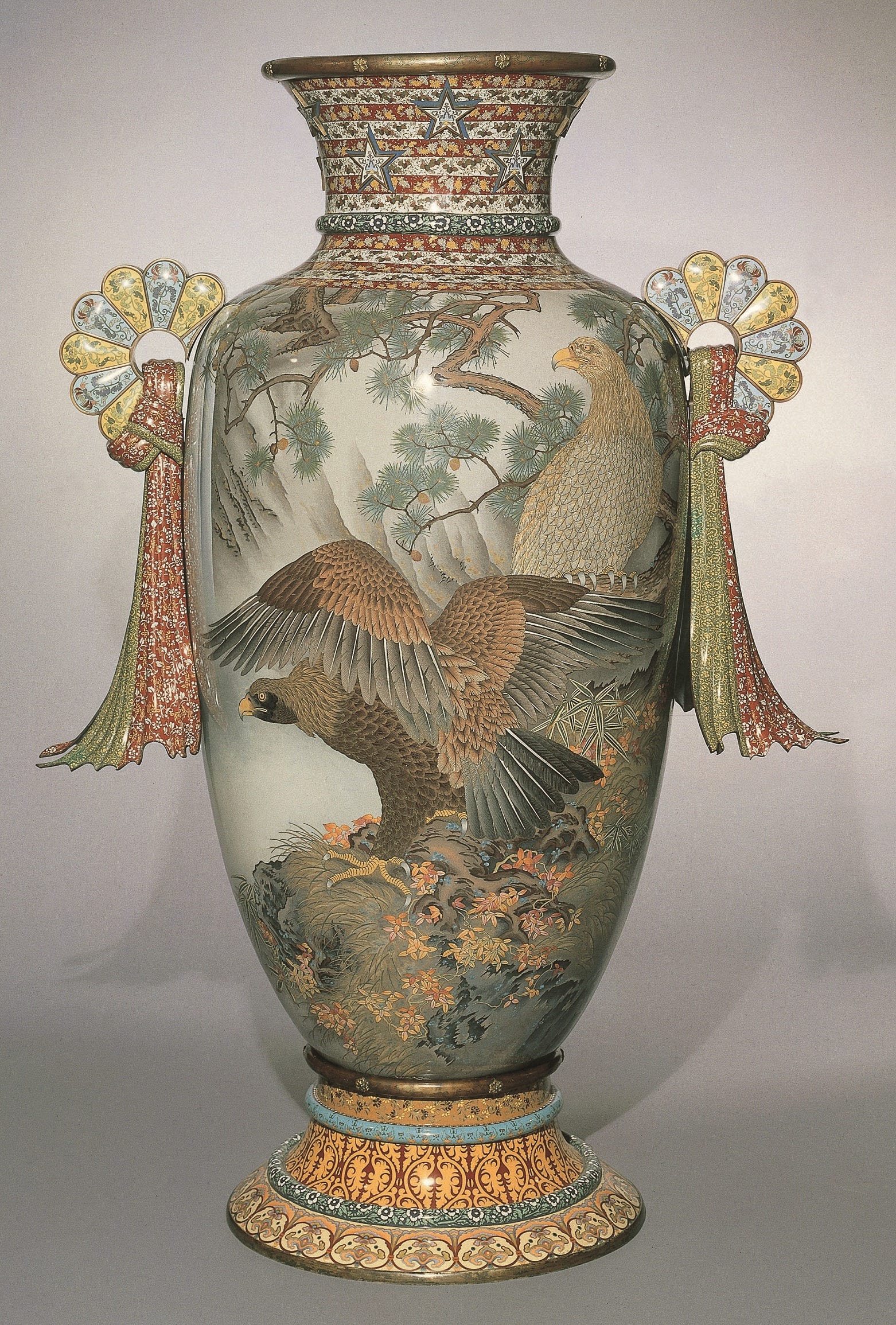
One source said that they were exiled to the Manufacturing and Liberal Arts building because the fair managers didn’t approve of the political message on the pieces, which had symbols of China, Russia, and Korea, but I suspect that’s looking back through the lens of later history. That article seemed unaware that by July 23, 1893, they were in the Palace of Fine Arts. I suspect the problem was that, in the utter chaos of trying to mount the art in the Palace of Fine Arts, someone just didn’t value their stunning beauty until Mr. Shinwoda convinced them. I’m sure he was very convincing. After all, Japan spent more than any other nation at the fair.
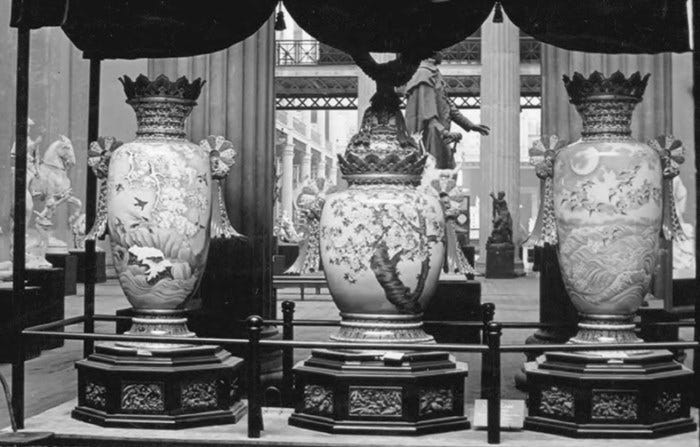
After the fair, in November 1893, the Japanese exhibit was packed up and the trail ran cold…until Sir Nasser David Khalili decided to track them down for his many collections. I’d not heard of him before this search, but I’m glad he linked them together again.
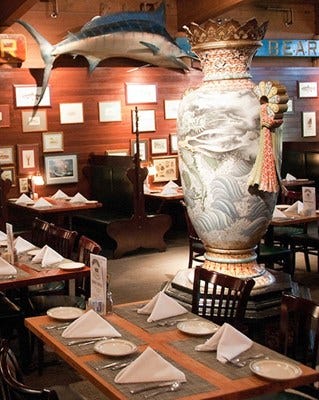
In 1990, the Khalili Collection tracked down one of the vases in Los Angeles and acquired it. In 2000, the collection bought the censer from the Tokyo National Museum, but there was no trace of the other vase—until 2019. Spenger’s Fresh Fish Grotto in Berkeley, a restaurant owned for generations by the Spenger family, held an auction, and there it was in the auction catalog. It’s not entirely clear from the articles whether Frank Spenger had purchased it at the Columbian Exposition and taken it to the California Midwinter Fair in San Francisco, or whether the whole exhibit had gone to the Midwinter Fair and Spenger had purchased it there. In any case, everyone agrees that it stood in the middle of folks eating fish for 120 years, under the watchful eye of the stuffed fish on the wall.
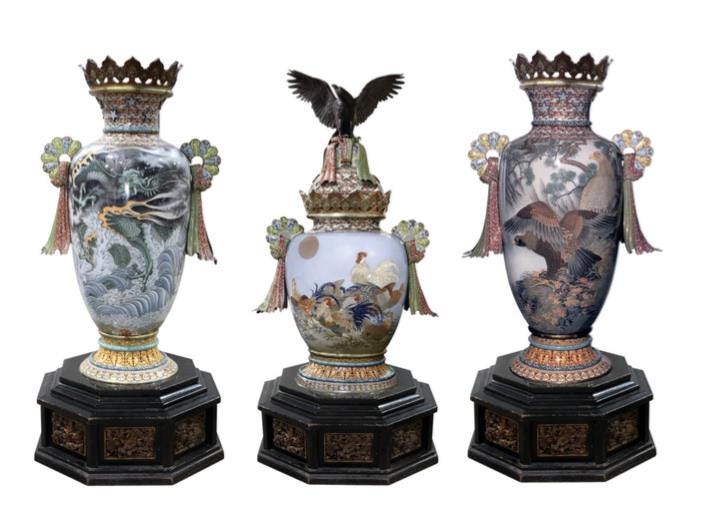
The Khalili Collections bought it and brought the three together for the first time since 1894. As the Khalili website says, “After over 120 years of separation, the famous three-piece garniture has finally been reunited in The Khalili Collections’ Japanese Art of the Meiji Period (1868-1912), finding their rightful place in what is considered, alongside the Japanese Imperial Collection, to be the world’s most significant collection of its kind.”
So keep your eyes open. You might just be having lunch next to a Columbian Exposition treasure.
Wish I'd known all this when we were at Spengers last! Thanks, again!