Do Not Assume
Pursuing Paul Cornell

First of all, Part I in the Herald has come out, so if you want a coherent narrative of his life, check it out.

This substack is going to be about the point of not assuming received wisdom is wise.
Narratives of Hyde Park tend to say that U.S. Senator Stephen A. Douglas, who had bought a tract of land south of the Chicago border at 12th Street and who was instrumental in railroad development, told Paul Cornell to buy land south of his. This seemed to say that Cornell was a friend of Douglas. There is also an implication that Douglas knew the railroad was coming that way, so maybe too it was a bit of insider trading.
This led me to look for evidence for Cornell’s friendship with Douglas because, in the 1850s, that would say a lot about Cornell. Douglas was of course a Democrat defending State’s Rights, especially State’s Rights to enslave human beings. He was famously opposed to Lincoln. And, though he protested he didn’t live there, he himself was a person who owned people as property. His wife had inherited a Virginia plantation, a fact that was known at the time.
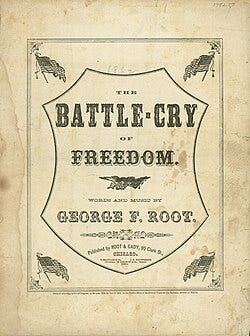
So, was Cornell a Democrat? No, he was not. Everything I could find made it clear that he was a Lincoln Republican. The newspapers in particular point to him as the only Republican appointed to the South Parks Commission when the Democrats voted to name the eastern park after Andrew Jackson. In addition, his lovely village attracted fervent friends and supporters of Lincoln, including Judd, who in 1860 put Lincoln’s staunchest supporters up in Cornell’s Hyde Park House so he could get them to the convention center en masse at the front of the room to shout for Lincoln and against anyone else. The men writing the music for the Union cause lived in Hyde Park. There was Henry C. Work, who bought land and a cottage in 1859—and I think these were bought from Cornell’s corporation. Work was there because music publisher George Root was in Hyde Park and involved in village business with Cornell. Root wrote, among other Union songs, “The Battle Cry of Freedom,” which sold over 700,000 copies. He wrote it as a recruitment song for the Union, but it also became a rallying song for enslaved residents of the South with its promise of liberation:
We will welcome to our numbers
The loyal, true and brave,
Shouting the battle cry of Freedom;
And although they may be poor,
Not a man shall be a slave,
Shouting the battle cry of Freedom.
For me, the deciding clue though was the fact that J. Y. Scammon was Cornell’s close colleague in his ventures, especially Oak Woods Cemetery and the South Parks Commission. Scammon was a personal friend of Lincoln, fervent Abolitionist, and rumored to have been an agent on the Underground Railroad. It was Scammon who brought Mary Todd Lincoln and her son to Chicago to recover after the assassination.
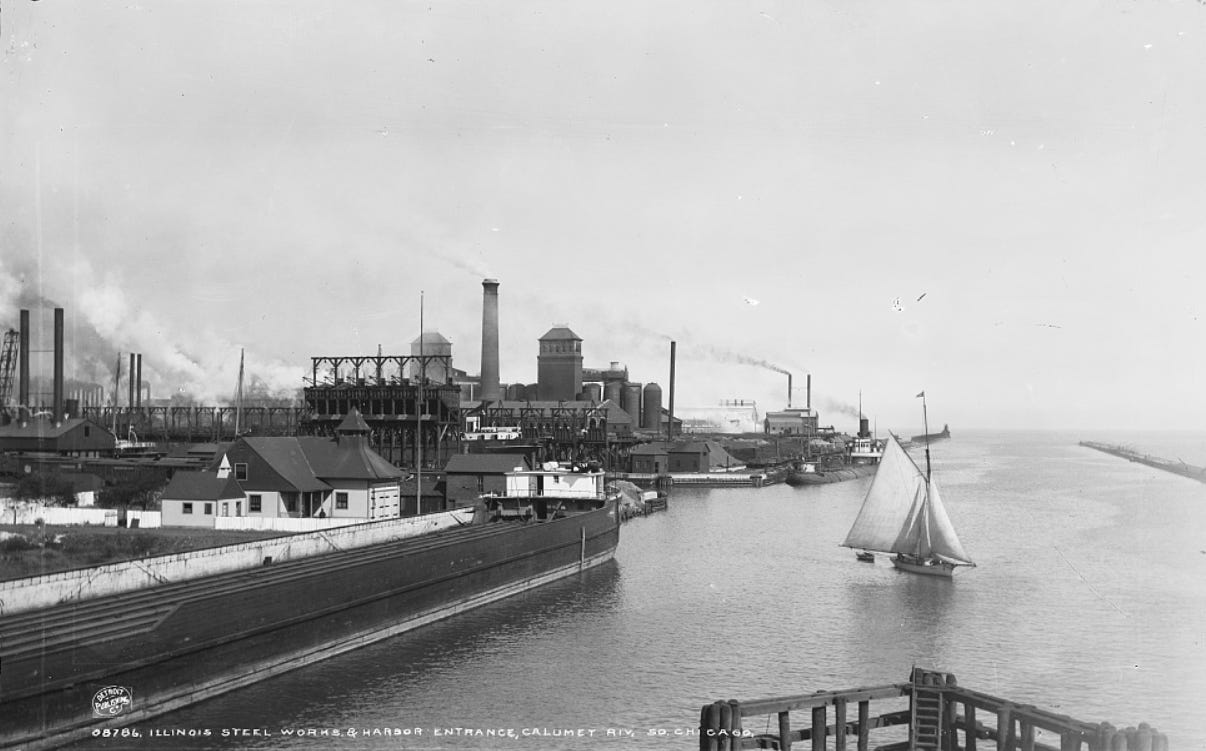
So, Cornell wasn’t a Democrat. Why was Douglas giving him real estate advice? According to Cornell, it was a chance encounter and at the time had nothing to do with railroads. According to Cornell later in life, he had newly arrived in Chicago in 1847, 25 years old, newly hired in a law firm in Chicago, when Douglas happened to stop by the law office. The conversation turned to the future of Chicago, which was a muddy, disease-ridden ramshackle place with a crappy river harbor that was shallow and kept silting up. The senior lawyers said development was sure to go north. Douglas said no, it would head south because the Calumet River was clearly going to be the much better natural harbor. He turned to the young Cornell and tossed off the advice that if a young man wanted to make his fortune, he’d acquire land between the Chicago and Calumet Rivers. Cornell then shaped his whole life around that nugget.
The story made a lot of sense of other puzzling things, so though the evidence is Cornell’s memory, it makes other things fall into place. Most of all, why was Hyde Park Township incorporated as such a huge hunk of real estate—48 square miles? It started at the then southern edge of Chicago and stretched to the Calumet River. Cornell wasn’t just waiting for the future to happen. 48 square miles of empty real estate. A few fishermen camped along the Calumet and that was about it. He wanted to push Douglas’s prediction along. For that he needed infrastructure and a tax base. He created a company to build a road from Chicago to the Calumet and to improve the docks on the river. Finally, that’s when he enlisted help from Sen. Stephen A. Douglas. In 1869, Congress gave money to dredge the harbor.
Cornell tried to lure industry to the Calumet a bit too early, when the area was still a mess. Once Pullman and the steel industry and Pullman turned up, he turned his energies elsewhere. He was real estate salesman first and foremost. But the kernel of an idea from Douglas suddenly makes the scale of Hyde Park Township make sense.
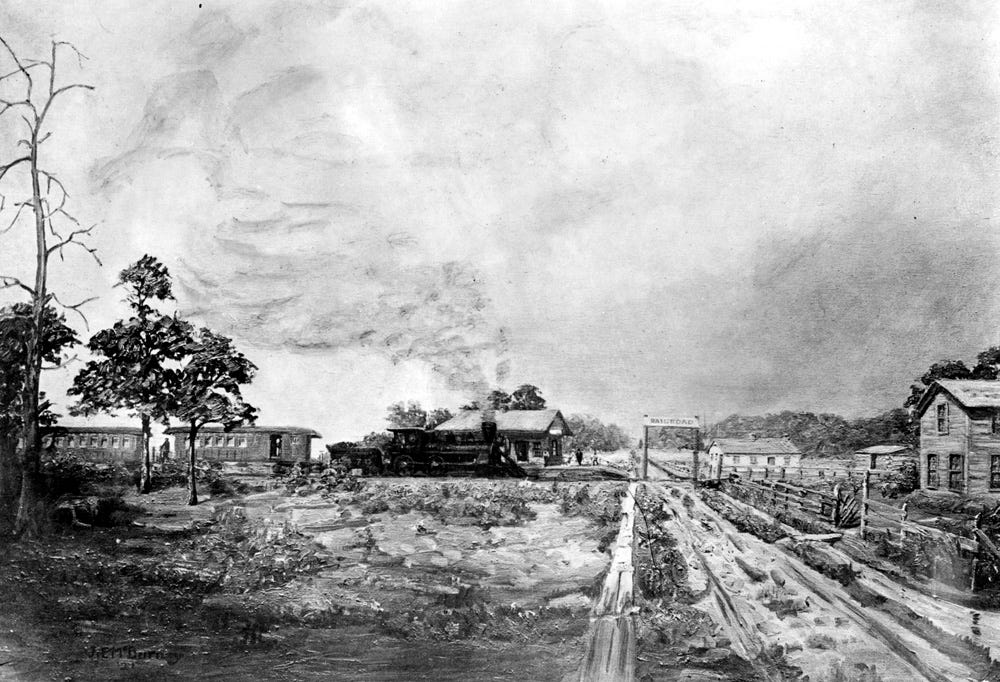
As for the railroad, as I spell out in the Herald article, that was all Cornell’s idea. No insider trading from Douglas at all. Even more, his land wasn’t on the original route of the railroad. So it wasn’t the case that the railroad needed him as some have said. He pursued the railroad to launch his idea of a pleasant village for commuters.
What I didn’t have room to explain in the Herald is that the germ of this idea occurred very soon after he arrived in Chicago. Cornell went to a talk by Justin Butterfield, a lawyer, who explained his idea of how they could finally get railroads launched. They’d been stalled since the 1830s because they required an inordinately huge investment before they earned even a dollar. Butterfield explained to a gathering of about 25 men that the federal government, which had seized indigenous lands, could grant that land to the railroads, which could then use it as collateral or sell it as well as build on it. When Butterfield’s plan passed Congress, Cornell was on the lookout for a way to attract a railroad to the land he was already acquiring.
When the Illinois Central struck a deal with the city to come into the city at 12th Street and the lakefront, Cornell saw his opportunity and sold the New York officers on the idea of cutting through the area that became Grand Crossing (where Cornell owned land) to the land Cornell owned along the lakefront far south of 12th Street.
The other part of the story that conventional wisdom elides is just how good a salesman Cornell was. There’s a repeated factoid that he traded 60 acres in exchange for his commuter train. At first, he sold the ICRR instead on the idea of being part owners of his village corporation—for a village that didn’t exist with a commuter train with no commuters. He was such a good salesman it worked for awhile. A few years later, the ICRR sobered up and said they were losing money. He had to come up with incentives to get them to stay and then did indeed give them 60 acres of his land in order to keep the train running.